How Foreigners Can Register a Company in Japan:
A Complete Guide

Japan has become an increasingly attractive destination for international entrepreneurs, investors, and business owners seeking opportunities in one of Asia’s most advanced and stable economies. With its strong infrastructure, reliable business environment, and access to the wider Asia-Pacific market, Japan offers significant opportunities for foreigners looking to establish a long-term business presence.
After relocating to Japan, many foreign entrepreneurs consider starting or expanding their business through options such as:
Starting a business in Japan
Opening a trading company
Operating a cross-border e-commerce business
Establishing a Japanese corporation
Opening a branch office in Japan
Applying for a Business Manager Visa
However, establishing a company in Japan requires more than simply completing registration paperwork. Foreign entrepreneurs need to understand local regulations, select the appropriate corporate structure, prepare the necessary documents, and navigate various administrative procedures. This guide provides an overview of the company registration process in Japan, helping foreign entrepreneurs better understand the key steps, requirements, and considerations before starting a business in Japan.
1. Can Foreigners Register a Company in Japan?
Yes. Foreigners can legally establish and own a company in Japan, even without Japanese citizenship or permanent residency status.
Japan has removed the previous requirement that a company must have a Japanese national as a representative director, making it possible for foreign entrepreneurs to establish businesses and operate companies in Japan.
However, setting up a company in Japan requires careful preparation, including choosing the appropriate corporate structure, preparing required documents, securing a registered office address, and completing the necessary administrative procedures.
Foreign entrepreneurs establish businesses in Japan across a wide range of industries, including:
Cross-border e-commerce
International trade and import/export
IT development and technology services
Restaurants and food-related businesses
Vacation rental and hospitality businesses
Study abroad and education services
Consulting companies
Self-media and content creation businesses
Whether you are planning to launch a new business, expand an existing company, or apply for a Business Manager Visa, understanding Japan’s company registration process is an essential first step.

2. Choosing the Right Company Structure in Japan: KK vs GK
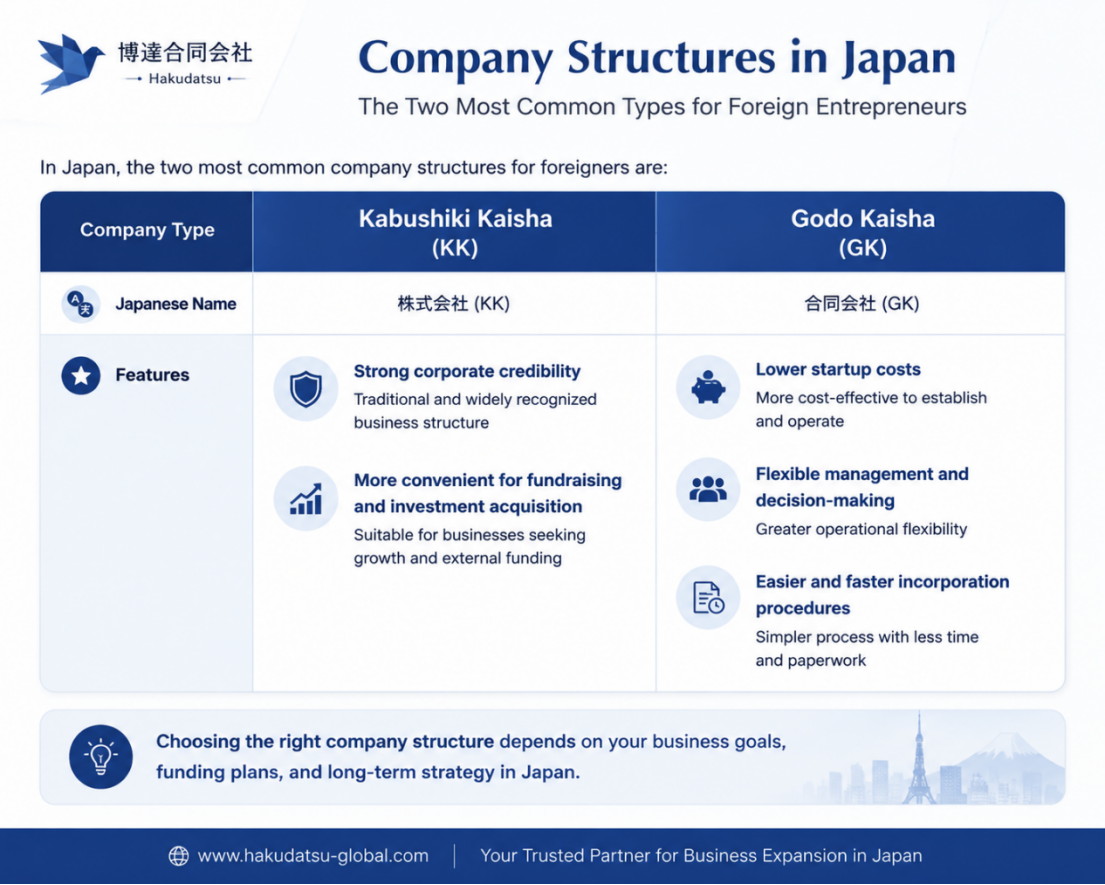
When establishing a company in Japan, foreign entrepreneurs typically choose between two main corporate structures: Kabushiki Kaisha (KK / 株式会社) and Godo Kaisha (GK / 合同会社).
Both structures allow foreigners to legally establish and operate a business in Japan, but they differ in terms of corporate credibility, management flexibility, setup costs, and future growth potential.
Godo Kaisha A Godo Kaisha (GK), similar to an LLC in the United States, has become an increasingly popular modern company structure in recent years due to its flexibility and cost-effectiveness.It is especially suitable for small and medium-sized businesses, independent entrepreneurs, and foreign companies establishing subsidiaries in Japan.The establishment cost is relatively low, and the internal management rules are much more flexible compared to traditional corporate structures.Decision-making is faster, and unlike a KK company, the executive members of a GK do not have fixed term limits, which reduces ongoing administrative procedures and corporate formalities.
Kabushiki Kaisha (KK) — 株式会社
A Kabushiki Kaisha (KK) is the traditional Japanese corporation structure and is the most widely recognized type of company in Japan.
KK is often preferred by businesses that aim to build a strong corporate image, work with larger Japanese companies, attract investors, or expand operations in the future.
Key Features:
1. Strong Corporate Credibility
KK companies are widely recognized by Japanese businesses, financial institutions, and customers. The structure is often associated with established companies and long-term business operations.
2. Suitable for Growth and Investment
A KK structure is generally more suitable for companies seeking external investment, fundraising opportunities, or future expansion.
3. Greater Corporate Recognition
For businesses planning to develop partnerships with Japanese corporations or build a strong local brand presence, KK can provide additional credibility.
Suitable For:
Companies planning long-term expansion in Japan
Businesses seeking investors or external funding
Companies working with Japanese corporations
Businesses that prioritize corporate reputation
Godo Kaisha (GK) — 合同会社
A Godo Kaisha (GK) is a more flexible company structure that is often chosen by entrepreneurs who want a simpler and more cost-effective way to establish a business in Japan.
Similar to a Limited Liability Company (LLC) in other countries, GK provides operational flexibility while maintaining limited liability protection.
Key Features:
1. Lower Startup Costs
Compared with KK, GK generally requires lower incorporation costs and fewer administrative procedures.
2. Flexible Management Structure
GK allows greater flexibility in decision-making and internal management arrangements, making it suitable for smaller businesses and owner-operated companies.
3. Simpler Incorporation Process
The establishment process is generally more straightforward, making GK an attractive option for entrepreneurs who want to start operations efficiently.
Suitable For:
Small and medium-sized businesses
Individual entrepreneurs
Consulting businesses
Online businesses and e-commerce companies
Entrepreneurs prioritizing flexibility and cost efficiency
KK or GK: Which One Should You Choose?
The right company structure depends on your business goals, investment plans, and long-term strategy in Japan.
A KK may be more suitable if your priority is corporate credibility, fundraising, and future expansion.
A GK may be a better choice if you are looking for a simpler setup, lower costs, and flexible management.
Before establishing a company in Japan, it is important to evaluate your business model, growth plans, and residency objectives to select the structure that best fits your needs.

3. What Are the Requirements for Registering a Company in Japan?
To establish a company in Japan, foreign entrepreneurs need to prepare several key requirements, including the company name, registered address, capital, and business activities.
The specific requirements may vary depending on the business structure and individual circumstances, but the following elements are generally required.
1. Company Name
When registering a company in Japan, the company name must meet certain requirements.
Requirements:
The company name can be written in Japanese, English, or Chinese characters
The name must not be identical or confusingly similar to an existing registered company
The company type must be included in the official company name:
Examples:
Choosing an appropriate company name is important, as it represents your business identity and will be used for official registration, contracts, and business operations.
2. Registered Business Address in Japan
A registered business address in Japan is required when establishing a company.
Possible options include:
The appropriate office arrangement depends on your business activities, operational needs, and whether you plan to apply for a Business Manager Visa.
3. Registered Capital
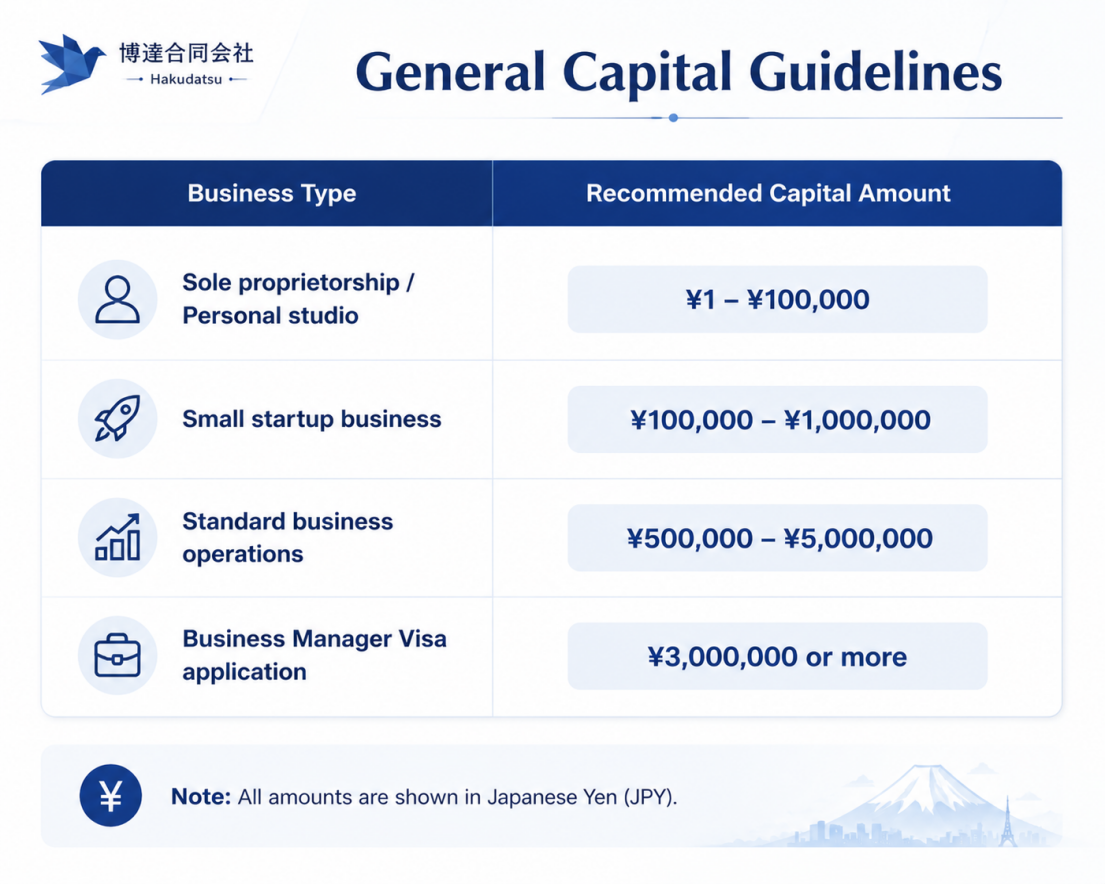
Under Japanese company law, it is technically possible to establish a company with capital as low as 1 yen.
However, choosing the appropriate capital amount is an important business decision.
The recommended capital depends on factors such as:
Industry type
Business model
Operational costs
Future growth plans
Visa requirements
Simply registering a company with minimal capital is generally not recommended, as insufficient capital may affect business credibility, banking procedures, and future planning.
4. Business Activities / Scope of Business
When registering a company in Japan, you must clearly define the scope of business activities in the company’s Articles of Incorporation.
Common business activities include:
International trade and import/export
E-commerce operations
IT development and technology services
Marketing and consulting services
Translation services
Food and restaurant businesses
Agricultural product trading
Real estate-related businesses
Recommendation:
It is generally advisable to carefully plan your business scope during the initial registration process and include potential future activities where appropriate.
Adding new business activities after incorporation may require additional procedures, administrative work, and costs.
For this reason, entrepreneurs should consider both their current business model and future expansion plans when preparing company registration documents.

4. Complete Company Registration Process in Japan
Establishing a company in Japan involves several important steps, from deciding the company structure and preparing legal documents to completing registration with the Japanese authorities. While the process may seem complex for foreign entrepreneurs, understanding each stage in advance can help ensure a smoother and more efficient setup process.
Below is the standard company registration process in Japan.
Step 1: Decide the Company Information
Before starting the registration process, you must determine the basic details of your company, including:
Company name
Registered office address
Registered capital amount
Shareholders
Directors / Representative Director
Business activities and scope of operations
Careful planning at this stage is important, as these details will affect your company structure, future operations, and potential visa applications.
Step 2: Prepare the Articles of Incorporation
The Articles of Incorporation (Teikan / 定款) serve as the official legal document that defines the company’s purpose, structure, and operating rules.
Requirements differ depending on the company type:
For a Kabushiki Kaisha (KK / 株式会社), notarization of the Articles of Incorporation is required.
For a Godo Kaisha (GK / 合同会社), notarization is generally not required.
Step 3: Create Company Seals
第三步:制作公司印章
Japanese companies commonly use official corporate seals for business and administrative procedures.
The typical company seals include:
These seals are used for official documents, contracts, banking procedures, and company administration.
Step 4: Deposit the Registered Capital
Before the company is officially incorporated, the registered capital must be transferred into the personal bank account of the founder or investor.
As part of the registration application, you will generally need to provide:
Bank transaction records
Proof of capital deposit
These documents demonstrate that the required capital has been properly prepared.
Step 5: Submit the Registration Application to the Legal Affairs Bureau
After preparing all required documents, the company registration application is submitted to the relevant Legal Affairs Bureau (法務局) in Japan.
The review process generally takes approximately:
7–14 business days
Once approved, the company will officially become a registered legal entity in Japan.
Step 6: Receive Company Registration Documents
After successful incorporation, the company will receive official registration documents, including:
At this stage, the company is officially established and can begin its business operations in Japan.
Although the company registration process itself is straightforward, foreign entrepreneurs should carefully consider factors such as company structure, office requirements, banking procedures, tax obligations, and visa planning before establishing a business in Japan.
Proper preparation at the beginning can help avoid unnecessary delays and create a stronger foundation for long-term success in Japan.

Your Trusted Partner for Establishing a Business in Japan
At Hakudatsu, we provide comprehensive end-to-end support for entrepreneurs, investors, and international companies seeking to establish and operate a business in Japan.
Entering a new market involves more than company registration. It requires a clear understanding of local regulations, business practices, administrative procedures, and operational requirements.
Our team combines local knowledge, professional networks, and international experience to help clients navigate the complexities of establishing a business presence in Japan.
From initial company formation planning to ongoing operational support, we assist clients throughout every stage of their Japan business journey.
Our services include company registration consultation, corporate structure planning, Business Manager Visa support coordination, corporate bank account setup assistance, and connections with local tax and accounting professionals.
With a strong commitment to professionalism, reliability, and service excellence, Hakudatsu aims to provide tailored solutions that meet each client’s unique business goals.
Whether you are an entrepreneur starting a new venture, an overseas company expanding into Japan, or an investor exploring opportunities in the Japanese market, we help you build a strong foundation for long-term success.
At Hakudatsu, we do more than support company establishment — we help international businesses confidently take their next step in Japan.
Feel free to contact us for more information.