|
How Much Income Do You Really Need for Japan Permanent Residence? 3 Key Points Under the New RulesHow Much Income Do You Really Need for Japan Permanent Residence? 3 Key Points Under the New Rules
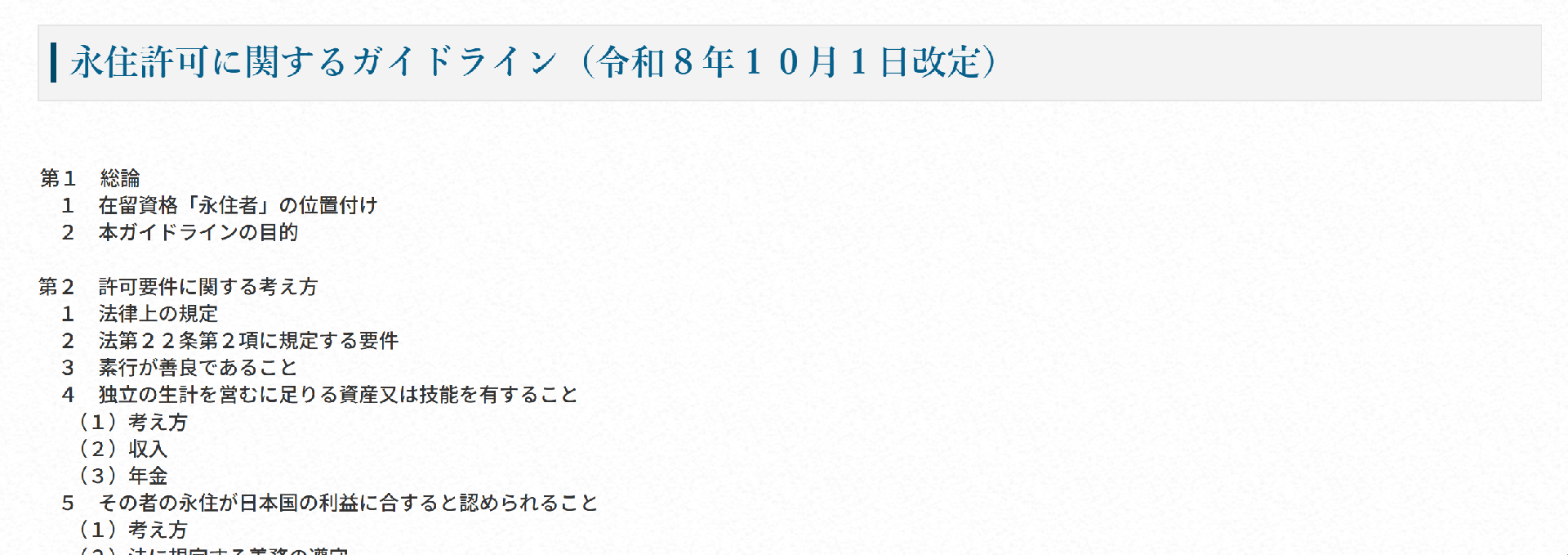
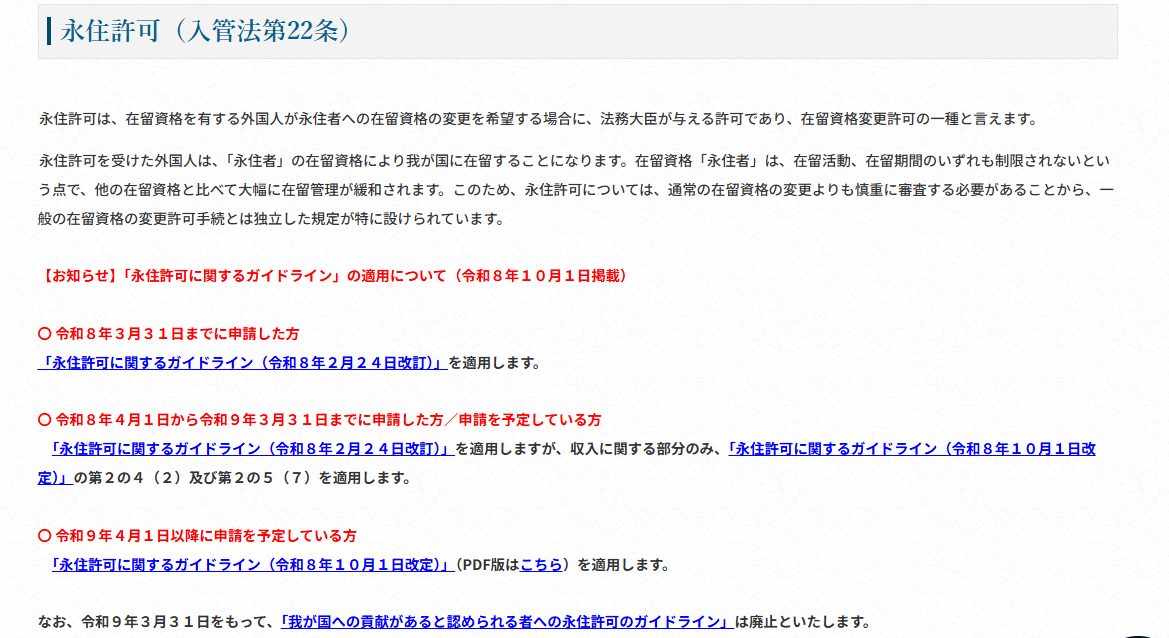
On October 1, 2026, the Immigration Services Agency of Japan officially released a revised version of its Guidelines Related to Permission for Permanent Residence. Since the new rules were announced, one of the questions people have been most concerned about is: “How much annual income do I actually need to apply for permanent residence in Japan?” Recently, many claims have also appeared online, such as: “From now on, annual income must be at least JPY 5.5 million.” However, according to the latest guidelines officially published by the Immigration Services Agency of Japan, the authorities have not established a single fixed nationwide income amount. In other words, it is currently not accurate to simply interpret the rule as:
What applicants should really pay attention to are the following three key points. The principle currently stated by the Immigration Services Agency is that the annual income of the applicant’s household must continuously remain above the average income level of Japanese households corresponding to the same household size. In principle, the economic requirement for permanent residence is assessed based on the household sharing the same livelihood. Key Point 1: It is not a fixed JPY 5.5 million — the reference level depends on household sizeThis is one of the most easily misunderstood parts of the new rules. The revised guidelines do not state: “All applicants must earn JPY 5.5 million.” Nor do they state: “Single applicants, married couples, and families of three are all assessed using the same standard.” The official approach is: Different household sizes correspond to different average income levels for Japanese households. For example, a single applicant and a married couple with two children have completely different living costs, dependent burdens, and household sizes. Therefore, income is not assessed simply by applying one fixed number to everyone. The revised guidelines clearly indicate that the authorities will examine whether the applicant household’s annual household income continuously reaches or exceeds the average annual income level of Japanese households with a corresponding household size. Ministry of Justice Therefore, when assessing whether your income is sufficient for permanent residence, you should no longer only ask: “Is an annual salary of JPY 5 million enough?” Instead, you first need to confirm: How many people are in your household? Who is counted as part of your household? Which sources of income can be included in the household income calculation? Only after confirming these points can a meaningful assessment be made. Key Point 2: Not all income earned by household members can necessarily be combinedMany families may think:
It is not necessarily that simple. The revised guidelines make clear that permanent residence income is assessed in principle on the basis of the household sharing the same livelihood, but whether a family member’s income can be included also depends on factors such as that person’s status of residence. For example, if a spouse holds a status such as Dependent (Family Stay), which is not primarily intended for employment, and only works limited hours under permission to engage in activities outside the scope of their residence status, such income is generally not suitable to be counted as part of the household’s qualifying annual income. In other words: “How much money everyone in the family earns in total” and “How much household income Immigration recognizes for permanent residence assessment purposes” may not be exactly the same thing. Therefore, households where a spouse earns part-time income should pay particular attention to the spouse’s current status of residence and the nature of that income when assessing permanent residence eligibility. Key Point 3: Dependents living overseas may also be counted as household membersThis point may have an even greater impact on many foreign residents in Japan. The revised guidelines clearly state: If the applicant supports dependent relatives, those relatives may be counted as members of the applicant’s household even if they live outside Japan. In other words, if you live in Japan but financially or for tax purposes support parents or other relatives overseas, those relatives may affect the household size used in the permanent residence assessment. As the number of household members increases, the corresponding reference income level may also increase. In particular, for households with five or more members, the revised guidelines also specifically mention that increases in living expenses resulting from larger household size must be taken into consideration. Therefore, some applicants who previously declared overseas dependents for tax or other reasons may need to pay closer attention to the relationship between the number of dependents and household income under the new permanent residence assessment environment. Is it true that “you must earn JPY 5.5 million every year for the last five years”?At present, there is no official basis for stating this as a fixed rule. The revised guidelines state that: Household annual income must continuously reach the corresponding required income level. However, the currently published guidelines do not state: “Annual income must exceed JPY 5.5 million in every one of the last five years.” Nor do they state: “JPY 5.5 million is the uniform standard for all applicants.” Therefore, treating JPY 5.5 million as a nationwide universal threshold for permanent residence is currently inaccurate. As for government statistics frequently mentioned online, such as the Ministry of Health, Labour and Welfare’s Comprehensive Survey of Living Conditions and the Statistics Bureau of Japan’s Family Income and Expenditure Survey, the revised Immigration guidelines currently do not explicitly specify which particular statistical dataset must ultimately be used as the sole calculation standard. For now, rather than immediately applying a “JPY 5.5 million standard” to yourself, it is more reasonable to wait for further clarification from Immigration and for actual case outcomes to provide additional guidance. Why do some people say “each year must be compared against that year’s average household income”?There is some logic behind this interpretation, but for now it should still be regarded as an interpretation of the phrase “continuously reach,” rather than an officially published fixed calculation formula. If Immigration later clarifies that applicants must be compared against the average income of Japanese households of the corresponding size for each individual year, then theoretically the following could occur: If the average income of Japanese households of the same size in a particular year is A, the applicant’s income for that year would need to be assessed against that level. If the average income changes in the following year, the corresponding reference level may also change. Therefore, future income assessments may be closer to the following approach: Rather than one fixed number remaining unchanged for five years, Immigration may examine whether the applicant’s income has consistently and stably remained at the appropriate economic level for the relevant period. However, this specific method of calculation has not yet been written into the publicly available guidelines, so it is not advisable to present this interpretation as if it has already been officially confirmed. Applicants who already submitted permanent residence applications in 2026 should also pay attention to the new income rulesThese income rules do not only affect people planning to apply from 2027 onward. The Immigration Services Agency of Japan has clarified that: Applications submitted on or before March 31, 2026 will, in principle, continue to be assessed under the previous guidelines. For: Applications submitted between April 1, 2026 and March 31, 2027 the previous permanent residence guidelines will generally continue to apply, but the income-related provisions of the revised guidelines dated October 1, 2026 will already apply. Applications submitted on or after April 1, 2027 will, in principle, be fully subject to the revised permanent residence guidelines issued on October 1, 2026. Therefore, if you submitted your permanent residence application after April 2026 and are still waiting for the result, you should now review: Has the number of people in your household changed? Do you have dependents living overseas? Is your income stable? Can your spouse’s income actually be counted? Have you recently changed jobs, experienced a drop in income, or had a long period without income? These factors may now be more important than simply remembering the number “JPY 5.5 million.” Income is not the only requirement for permanent residenceThere is another important point to remember: Even if your income reaches the relevant level, this does not mean permanent residence will automatically be approved. Permanent residence in Japan remains subject to a comprehensive assessment. The revised guidelines state that Immigration will comprehensively consider the applicant’s residence history, current and future income, assets, and skills, while also reviewing tax payments, pension contributions, social insurance, and compliance with legal obligations. Therefore, even an applicant with relatively high income cannot rely on income alone if there are problems with taxes, pension payments, social insurance, or other legal obligations. Conversely, applicants should not automatically assume that they “definitely cannot apply” simply because they have seen a particular income figure circulating online. The most important factors should be assessed together: Household size + countable household income + income stability + number of dependents + taxes and pension + residence history For Highly Skilled Professional applicants with 70 or 80 points, the applicable special permanent residence residence-period requirements should also be checked separately. If you are preparing to apply for permanent residence, check these items firstBefore applying for permanent residence in Japan, it is recommended to organize:
Applicants under the Highly Skilled Professional 70-point or 80-point system should also separately check whether they qualify for the relevant shortened permanent residence period. Conclusion: Do not focus only on “JPY 5.5 million”The most important part of these new permanent residence rules is not simply one number — “JPY 5.5 million.” What matters more are these three points: First, look at your household size. Second, determine which income can actually be counted by Immigration. Third, determine whether your income can continuously remain at a level appropriate for the size of your household. As of now, the Immigration Services Agency of Japan has not officially announced a rule stating that “all permanent residence applicants must have an annual income of JPY 5.5 million,” nor has it officially stated that “income must exceed JPY 5.5 million every year for the most recent five years.” Therefore, there is no need to become overly anxious simply because you see a particular number circulating online. A more reasonable approach is to first organize your household structure, income, dependents, taxes, pension contributions, and residence history. Hakudatsu will continue to monitor further explanations released by the Immigration Services Agency of Japan. If the authorities provide additional clarification regarding statistical standards, reference income levels, or calculation methods, we will continue to update the relevant information. If you are unsure whether your income and household circumstances align with the direction of the revised permanent residence assessment, you may also contact us for an initial review of your situation. → Japan Permanent Residence / Highly Skilled Professional |